Emergency work
Boiler and central heating in Zeist
A code on the display, radiators that stay cold, or hot water that never arrives.
Phone answered
07:00 to 22:00, every day
Travel time
usually 40 to 80 minutes
Call-out charge (voorrijkosten)
€ 25 on top before 08:00, after 18:00 and on Sundays
Problems
How we go about it
What you can do until we arrive. Copy the code off the display exactly as it appears, and find brand and model on the sticker under or behind the front cover; a photo of that sticker is plenty. Read the pressure gauge, which on a cold system should read somewhere between 1.5 and 2 bar. Press reset once and leave it: an appliance that drops out three times on one code is broken rather than sulking, and resetting it again only delays the diagnosis.
What we work on. Gas combi and system boilers. Radiators, the manifolds of underfloor heating, expansion vessels, circulation pumps, and the pipework tying all of it together. Stock in the van follows the failures: the pressure relief that has started weeping, the vent that has stopped venting, a filling loop, and an expansion vessel whose bladder has gone.
When replacing beats repairing. Once an appliance passes fifteen and the exchanger goes, repair is usually throwing good money after bad. You get both figures side by side, repair against replacement, and you decide in your own time. Nobody is going to lean on you for a signature at nine in the evening.
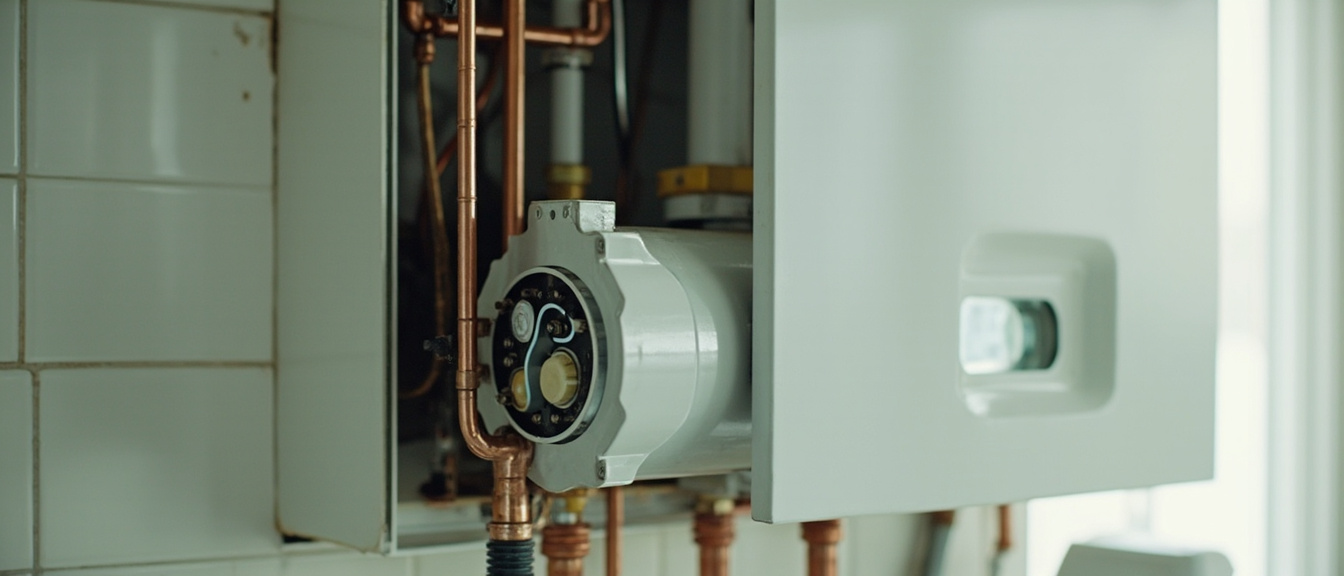
Heating in a Dutch home is nearly always one wall-hung gas combi boiler, tucked in the loft or a utility cupboard, doing the radiators and the hot tap from the same box. When it quits it usually says why, in the form of a code on its display. Those codes sort the fault into four separate worlds: pressure in the water, ignition of the gas, the flue, or the pump. Read the code down the phone along with the brand and the model off the sticker, and the part that fixes it travels out with the van instead of being ordered on Monday.
Pressure is both the most common cause and the most underrated one. A Dutch system is sealed and topped up by hand through a small filling loop, and below about 1 bar the boiler switches itself off rather than run dry. Refilling starts it again. But a system needing a top-up every month is losing that water somewhere, and refilling it is postponement dressed up as a repair.
Two things about this area change the diagnosis. The tap water off the Heuvelrug is hard, and hard water lays limescale down exactly where the heat is: on the plate heat exchanger and in a hot water cylinder. A boiler that takes forever to deliver hot water and knocks while it does so is far more often scaled than worn out. The second is a matter of layout: in the big detached houses here the run from boiler to the furthest bathroom holds so much cold water that it has to be pushed out before anything warm arrives. That is the plumbing design, not a fault, however much it feels like one at seven in the morning.
If a boiler genuinely has nothing left to give, you get told that with the reasoning attached. There is no appliance in the back of the van we are hoping to sell you tonight.
Can this wait until tomorrow?
Then there is no reason to sit in a queue. Put your number in the form with a line about what is going on, and the call back comes at an hour you name yourself. Write it in English.
Amounts
What it costs
One set of figures for the whole site. No emergency tariff exists that waits until somebody is standing in your hallway to introduce itself.
All rates and how time is counted
If the job takes longer than estimated.
On the doorstep you are told what looks necessary and roughly what that comes to. Should the job turn out bigger, you hear it while the panel is still off, not two weeks later on paper. Nothing past € 400 happens until you have said yes to it.
| Item | Amount |
|---|---|
| Call-out charge | € 45 |
| Hourly rate | € 65 to € 85 |
| Out-of-hours surcharge | € 25 |
| After the first hour | per 15 min |
| Parts | separate |
One call-out charge covers the visit. Tap and sanitary work bill at the lower hourly figure; jetting, camera work and boilers at the higher one. A flat amount joins the bill before 08:00, after 18:00 and on Sundays, never a percentage of anything. Quarter hours are counted after the first hour, and every part gets its own line.
What matters here
Background
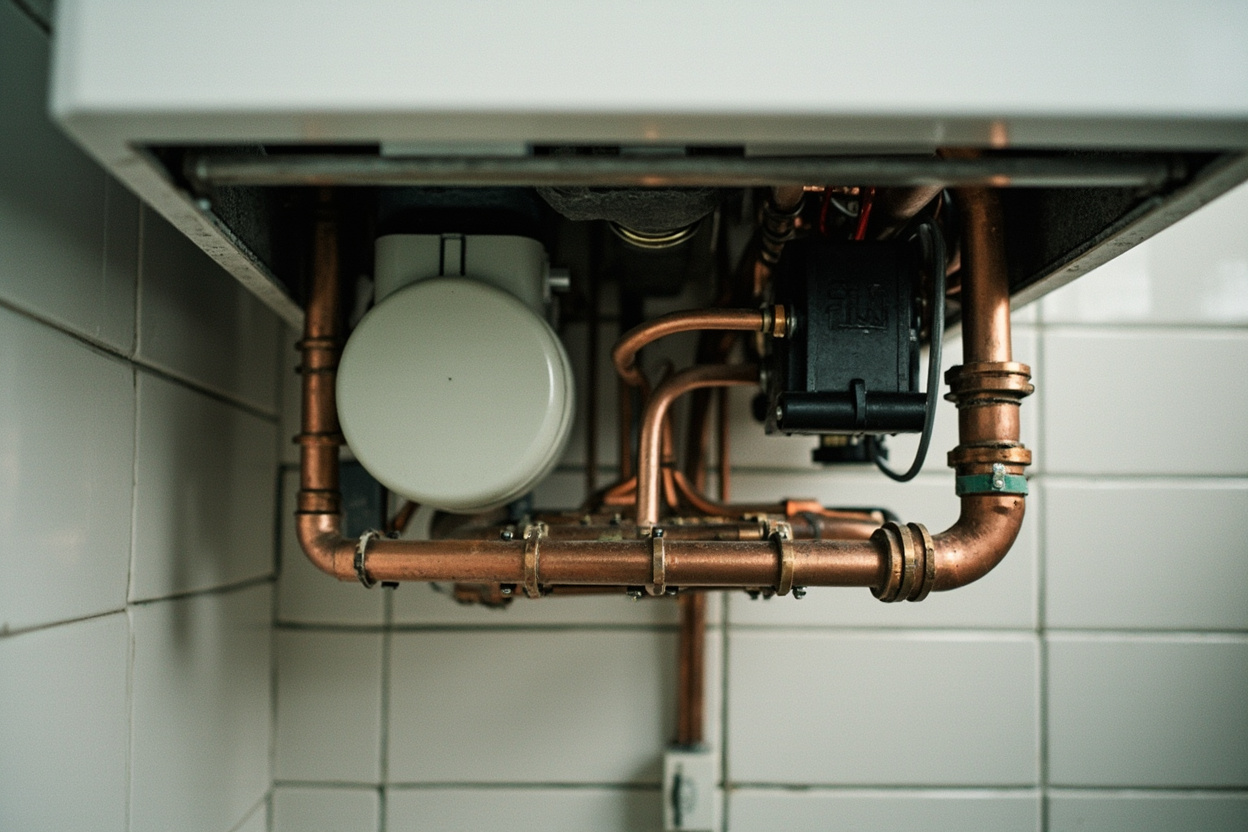
Four complaints cover most call-outs: hot water gone while the radiators still warm up, radiators cold along the top edge, a boiler that lights for a few seconds and drops out, and water pooling under the appliance. Different causes, different repair times, and on the phone they are almost always distinguishable from one another.
Heating fine but no hot tap points at the plate exchanger, or at the diverter valve that decides where the heat goes. Both are components rather than appliances, and that distinction is the difference between an afternoon and a new boiler. A cold top edge on a radiator is trapped air: bleed it, then bring the system back to about 1.5 bar. Every Dutch radiator has a small square bleed nipple in the top corner and the key costs about a euro, so this one is genuinely yours to do. Water underneath the boiler is more often the expansion vessel (expansievat) or the pressure relief valve than a split exchanger, and the difference between those two is a factor of ten on the invoice.
Austerlitz needs its own paragraph once the frost arrives. The village sits high and exposed on the open heath, several degrees rawer than the rest of the municipality on a clear night, and pipework in an unheated utility room, garage or extension freezes there first. Draining the outside tap in November is the cheapest plumbing job in existence, and it is one you can do with a screwdriver.
One instruction outranks calling us. Smell of gas: everyone outside, then ring the national gas emergency line on 0800 9009, free and staffed around the clock. That is not a plumbing job, it is an emergency service, and it goes first.
Where we come for this
- Plumber in Zeist (30 to 60 minutes)
- Plumber in Den Dolder (35 to 70 minutes)
- Plumber in Austerlitz (40 to 80 minutes)
- Plumber in Bosch en Duin (35 to 70 minutes)
Not sure whether this counts as an emergency?
Water standing on a floor, nothing working at all, a drain backing up over the rim: ring. Anything that can stay as it is until tomorrow can go through the form, and it will be at the top of the list early in the morning.
What should I have to hand when I ring?
Three things: the code showing on the display, the brand and model, and the reading on the pressure gauge. Those three between them usually settle which part is needed, and a part decided in advance is a second visit and a second call-out charge that never happen.
Cold along the top of every radiator. Has something broken?
Usually not. Air rises through a heating system and parks at the highest point it can find. Let it out at the bleed nipple, top the pressure back to around 1.5 bar, and it is done, with your own bleed key. Air that is back inside a few weeks is a different story: then the system is drawing it in or losing water, and something really has failed.
Hot water takes ages and the boiler ticks. Is that limescale?
Very likely. Water on the Heuvelrug is hard, and scale settles where the temperature peaks, which means the plate exchanger and any storage cylinder. A scaled appliance gets noisy, delivers less hot water and burns more gas doing it. Chemical descaling is possible; whether it pays depends almost entirely on how old the boiler already is.
Do you handle heat pumps?
Everything on the water side: leaks, loss of pressure, manifolds, radiators and pipework. The refrigerant circuit, no. That needs a certification we do not carry, and telling you so on the phone is better than telling you so in your hallway. If the pump came with a housing association or an energy contract, the installer named in that contract is the quicker route anyway.
The other problems we fix
Not urgent
Leave us your number
This is for anything that can keep until tomorrow. Standing water, or nothing working at all, belongs on the phone instead: nobody watches this form all evening. English is fine.